
Haarlem is the day trip I'd send you on first. The ride is short enough that you barely settle into your seat. Then the town hands you canals, a big market square, serious museums and a good lunch, all on foot and with no rush. Of all the best day trips from Amsterdam by train, Haarlem asks the least planning and pays back the most. If it doesn't suit you, Utrecht, Delft and Leiden are the next three I'd look at.
What are the best day trips from Amsterdam by train?
Ten trips are worth a day of your time. They fall into a few clear types: small old cities, bigger cities, the beach, the windmills, and quiet harbour towns. Here they are, ranked from my first pick down, with the one reason to go and the one reason to skip.
| Pick | Ride from Amsterdam Centraal | Best for | Skip it if |
|---|---|---|---|
| Haarlem | Among the shortest hops | An easy old-town day with museums and food | You want somewhere that feels far from Amsterdam |
| Utrecht | 26 minutes on the fastest trains | Canal-side terraces and café time | You only want small and sleepy |
| Delft | About an hour, 55 minutes on the fastest train | Blue-and-white pottery and calm canals | A longer ride for a small town bothers you |
| Leiden | Shorter than Delft, on the same line | Museums and rainy days | You want big-city energy |
| The Hague | A little shorter than Delft | Art first, then the beach at Scheveningen | You want a pretty old town |
| Rotterdam | Longer than Delft on regular trains, quicker on the Intercity Direct | Modern architecture and food halls | You came for gables and canals |
| Zandvoort aan Zee | A short ride past Haarlem | A simple beach day | Wind and rain are forecast and you hate both |
| Zaanse Schans (via Zaandam) | 15 minutes to Zaandam, then a short connection | Windmills | You can't start early |
| Hoorn | A similar ride to Alkmaar | A quiet harbour town | You want lots of museums or nightlife |
| Alkmaar | 35 minutes | A compact market town and the cheese market | You can't go on a Friday and only care about cheese |
If you only read one part of this page, read this. Haarlem is the pick for an easy, pretty, low-effort day. Utrecht is the pick for sitting by a canal with a coffee. Delft and Leiden suit anyone who wants a small town with real history and a museum ready for when it rains.
Haarlem is the day trip to choose when you want zero fuss
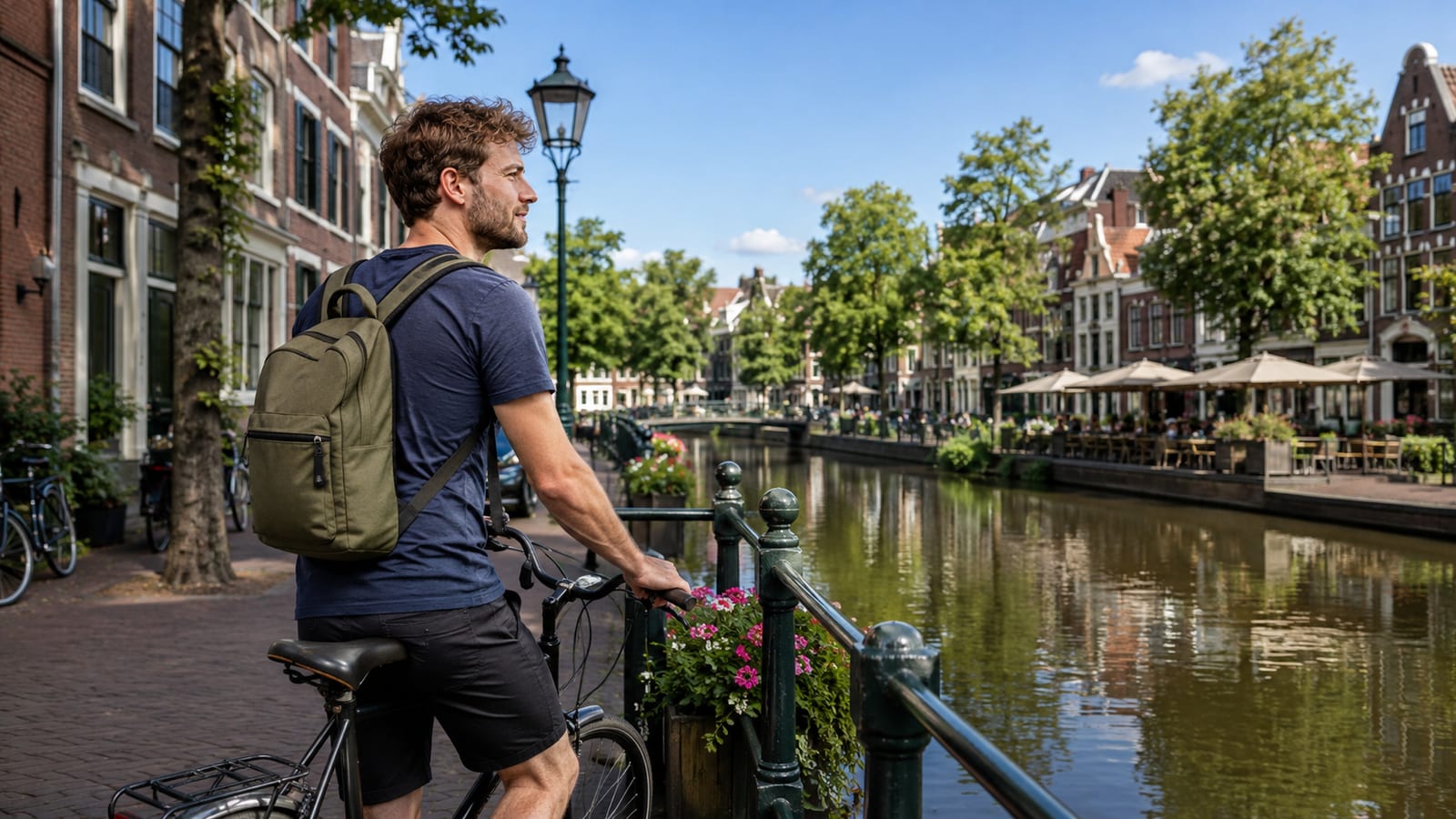
Haarlem wins because nothing about it fights you. The town is in North Holland, and its station sits at the edge of the old centre. The streets are flat and walkable, so you can arrive with no plan and still fill a day.
Before you leave the station, look up. The building is Art Nouveau, an ornate decorative style, and most people walk straight past its tiled panels. Then head south along Kruisweg and Kruisstraat into the centre.
Here's the loop I'd follow:
- Grote Markt, the main square, with St. Bavo church on one side. On Saturdays the square fills with market stalls.
- East to the Spaarne river and the Teylers Museum, a gloriously old-fashioned room of fossils, instruments and drawings.
- North along the water to De Adriaan, a windmill on the river bank, if you want one windmill without a tour bus.
- Back to the Frans Hals Museum, Haarlem's art museum, founded in 1862 and full of Dutch Golden Age portraits.
For lunch, skip the terraces that face the church. Instead, walk one street back into the lanes between St. Bavo and the river. You can grab a coffee and a broodje there (a filled roll, the standard Dutch lunch) without paying extra for the view.
The downside is honest and small. Haarlem looks a lot like a calmer Amsterdam, so it won't feel like a change of scene. If contrast is what you want, Rotterdam does that better.
Choose Utrecht for canals, Delft for pottery, and Leiden for museums
These three are the classic small-city alternatives. Each one is good, but they suit different people. Match the town to what you enjoy, and you'll have a better day than if you pick whichever name you've heard most.
Utrecht: canals and café time
Utrecht, in the province of the same name, is the closest of the three. What sets it apart is the Oudegracht, the old canal. Its old wharf cellars sit at water level and have been turned into cafés and terraces. You sit right down by the water, below the street, while bikes rattle past overhead.
The city feels lived-in because a big student population keeps it busy all year. That makes it the best of the three for a solo traveller who likes to sit with a coffee and watch people. If you have the legs, climb the Dom Tower, the tallest church tower in the country. Visits run as guided tours, so book a slot when you arrive.
One catch: the walk out of Utrecht Centraal runs through a huge shopping mall. Follow the signs for the centre and keep going, because the old town starts right after.
Delft: pottery and quiet canals
Delft is the longest ride of the three, and it's worth it if you like small and pretty. The Markt square has the Nieuwe Kerk at one end and the City Hall at the other. The canals off it are some of the calmest you'll find.
Delftware, the blue-and-white pottery, is why most people come. You can watch it being hand-painted at Royal Delft, the last of the town's original factories. However, the souvenir shops near the Markt sell plenty of printed copies. If you're buying, look for pieces that are hand-painted and signed.
Leiden: history and museums
Leiden sits on the same line as Delft but closer to Amsterdam. It's the oldest university town in the country, and the Rapenburg canal is lined with grand houses and student bikes. This is the one I'd pick when it rains.
The Rijksmuseum van Oudheden, the national museum of antiquities, has a real Egyptian temple inside. Naturalis covers natural history and has a dinosaur hall kids love. Meanwhile, the Hortus botanicus is one of the oldest botanical gardens in the world, with glasshouses for wet afternoons. The museums are spread across town, so choose two and leave the rest for another trip.
The Hague and Rotterdam make the best big-city escapes

Take the longer ride when you want a real city with its own personality. Both have more going on than Haarlem or Utrecht. They also ask more of you: more distance on foot, more trams, more choices.
The Hague is the seat of government and the grander, quieter of the two. Its big draw is the Mauritshuis, a small museum where you can stand close to Vermeer's Girl with a Pearl Earring. Next door is the Binnenhof, the parliament complex, though long renovation work means you should expect scaffolding. Afterwards, take a tram out to Scheveningen, the city's beach district, for a pier walk and fish by the sea.
One small detail saves you time. Some trains from Amsterdam stop at Den Haag Centraal and others at Den Haag HS. Centraal is the one within walking distance of the Mauritshuis.
Rotterdam is the opposite of postcard Netherlands. Most of the old centre was destroyed by bombing in the Second World War, and the city chose to rebuild bold and new. Start at the Markthal, a huge arched food hall with a painted ceiling. Then walk to the Cube Houses next door and cross the Erasmus Bridge on foot.
The trade-off is size. Rotterdam is spread out, so you'll use the metro or tram for part of the day. The fastest route is the Intercity Direct over the high-speed line, which charges a small extra fee on top of your normal fare.
Zandvoort is the easy beach day by train
Zandvoort aan Zee is the easiest beach from Amsterdam because the station sits a short walk from the sand. The line runs on from Haarlem, so the ride is barely longer than Haarlem itself. Direct trains run from Amsterdam, and if yours doesn't, change at Haarlem.
In summer the beach is lined with pavilions, wooden beach cafés that rent loungers and serve food. On hot weekends it gets crowded, because a lot of Amsterdam has the same idea. Go on a weekday if you can.
Out of season it's a different place. Many pavilions stay open, the wind is strong, and you'll share a wide grey beach with dog walkers. That's worth it if you like a bracing walk, but bring a proper jacket. Behind the town, the dunes of Zuid-Kennemerland National Park have walking and cycling trails for when the beach is too windy.
If the day is long, pair it with Haarlem. Spend the morning in town, take an early afternoon train to the coast, and stay for the evening light over the sea before heading back.
Zaanse Schans has the windmills, but go early
Zaanse Schans is a cluster of working windmills and green wooden houses along the Zaan river. It's the quickest way to see the windmills you pictured before you came. It's also one of the most crowded spots in the country by late morning, when the tour buses arrive.
Here's the route. Zaandam is a quick train ride from Amsterdam Centraal. From there you can take a bus. Or stay on a Sprinter, the slower stopping train, a little further up the line to Zaandijk Zaanse Schans station and walk across the bridge over the river.
Walking around the village costs nothing. Still, the windmill interiors and small museums charge entry, so pick the one or two you care about. Many of the houses were moved here from around the region to save them. As a result, it's closer to an open-air museum than a working village.
If you want a real town too, stop in Zaandam on the way back. The Czar Peter House is where Russia's Peter the Great lodged while he learned shipbuilding. Next to the station, a hotel built to look like stacked green Zaan houses is worth a look.
Hoorn and Alkmaar are the quieter harbour and market towns
Both towns sit north of Amsterdam, on the side most day-trippers never see. Both feel more local than the windmill circuit. They suit you if you'd rather wander than queue.
Hoorn was a powerful trading port in the Golden Age. The old Hoofdtoren tower still stands at the water's edge, and the Roode Steen square, home to the West Frisian Museum, marks the centre. Come for a slow harbour walk, gabled streets and a fish lunch. On a grey weekday out of season it can feel almost too quiet, so it suits someone who wants calm more than activity.
Alkmaar has a compact, canal-ringed centre. The reason to time your visit is the cheese market outside the Waag, the old weigh house, held on Friday mornings in the warmer months. Porters dressed in white carry cheeses on wooden sledges while a crowd watches.
The show is staged for visitors, and everyone knows it. Even so, it's worth it, so arrive early for a spot at the front. My rule: choose Hoorn for a quiet harbour, and Alkmaar if you can make a Friday.
How long are the train rides from Amsterdam Centraal?
Every trip on this page is short enough for a relaxed day. The rides fall into three bands:
- Quick hops: Zaandam, Haarlem and Zandvoort. These work as half days.
- Middle rides: Utrecht, Alkmaar, Leiden and Hoorn. These suit a full day with a late start.
- Longer rides: Delft, The Hague and Rotterdam. Leave by mid-morning so you're not rushing back.
You don't have to start at Centraal. Amsterdam Sloterdijk and Amsterdam Zuid also serve several of these routes, so check which station is closest to where you're sleeping. If you haven't booked a bed yet, my guide to the best areas to stay in Amsterdam covers which neighbourhoods sit near which stations.
Tickets are simple. You can tap in and out at the card readers with a contactless bank card, or buy a ticket from a machine or the app. Always tap out at the end. If you forget, you're charged a high default fare, which is a real cost for a small slip.
The transfers that matter are few. Zaanse Schans needs that last bus or Sprinter leg. The Hague needs the right station. Rotterdam is faster with the Intercity Direct supplement. Weekend track works sometimes swap trains for buses, so check the NS journey planner on the morning you leave.
Two-stop combinations that actually work
Two places in one day only works when they sit close together. These four pairs are comfortable:
- Haarlem and Zandvoort: town in the morning, beach in the afternoon, on the same line.
- The Hague and Scheveningen: the Mauritshuis, then a tram to the sea.
- Zaanse Schans and Zaandam: windmills early, then the town on your way home.
- Delft and Rotterdam: they sit close together on the same line, so pair old canals with new buildings.
Skip any pairing that crosses the country. Utrecht with Delft, or Alkmaar with Rotterdam, means you spend the best hours of the day on trains. Three towns in a day is a train ride with short breaks.
Which trip fits the day you actually have?
Start with your time. With only half a day, go to Haarlem or make an early run to Zaanse Schans. A full free day opens up Delft, The Hague or Rotterdam.
Then check the weather. When it rains, Leiden and The Hague have the museums, and Rotterdam's Markthal keeps you dry. If you'd rather stay in the city on a wet day, my list of the best museums in Amsterdam has options for every interest. On a sunny day, take Zandvoort or the Utrecht canal terraces.
For families, Naturalis in Leiden is the easy win. For a bigger outing, the Netherlands Open Air Museum in Arnhem shows how Dutch people lived in the past, but it's about 104 km (65 miles) away. That makes it a full day of train and museum, so start early.
Art lovers should pick The Hague first and Haarlem second. If you want countryside, the Zaan river and the Hoorn harbour are the greenest, calmest options here. And if you hate crowds, choose Hoorn or Leiden, and avoid Zaanse Schans at midday.
A simple day-trip plan that avoids the usual mistakes

Leave after the weekday morning rush. Trains are calmer, you'll get a seat, and you'll arrive as cafés open. Domestic Dutch trains don't need seat reservations, so there's nothing to book ahead.
Eat lunch early or late. Dutch lunch is light, often soup or a roll, and the best small cafés fill up right at midday. In smaller towns, kitchens close earlier in the evening than in Amsterdam, so eat dinner before you head back or plan to eat in the city.
Don't lock in a return time. Trains on these lines run often, so you can stay for the evening light or leave when your feet are done. That freedom is half the reason to go by train.
The biggest mistake is trying to tick off too much. One town done well beats three done badly. Save the extra hours for a quiet street, a second coffee, or some of the free things to do in Amsterdam when you get back.
Here's your first step. Tonight, open the journey planner, type in Haarlem, and look at tomorrow's departures after the morning rush. Then trust yourself and go.
FAQ
Is Bruges a realistic day trip from Amsterdam?
Technically yes, but I'd skip it as a day trip. The journey crosses into Belgium and usually involves a change, so you'll spend most of your waking hours in transit. International trains also need booking ahead, unlike Dutch domestic ones. Give Bruges at least one night.
Can I reach Keukenhof by train?
Not all the way. The flower gardens open only in spring and have no station of their own. Seasonal buses run from Schiphol and Leiden, so you take a train to one of those and finish by bus. Leave early, because the buses fill quickly on weekends.
Can I take a bike on Dutch trains?
Yes, with limits. A folding bike rides free as long as it stays folded. A regular bike needs its own day ticket and isn't allowed on board during weekday rush hours. Look for the bike symbol on the carriage door.
Is it safe to ride back to Amsterdam late on my own?
Dutch trains stay busy into the evening, and the big stations are staffed and well lit. Sit in a carriage with other passengers and keep your phone charged so you can check departures. Also know when the last train leaves before you settle into dinner. On the main lines, that's usually later than you'd expect.