
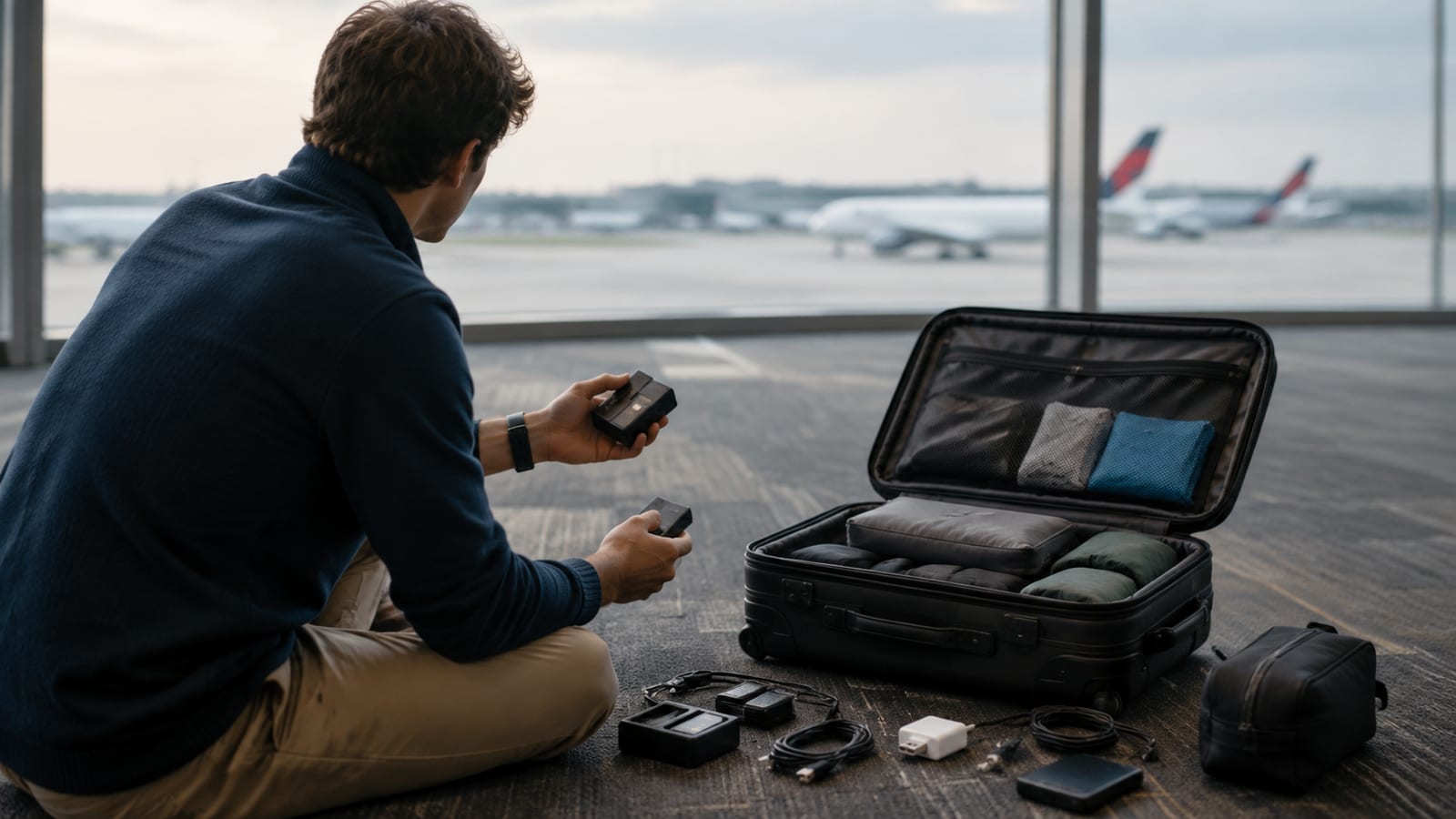
Yes, you can carry batteries on a plane, but loose lithium batteries belong in your carry-on. If you’re asking, “Can I carry batteries on a plane in checked luggage?” the safe answer is no for spares, power banks, and charging cases. Keep them in the cabin, cover the terminals, and ask the airline before bringing a lithium-ion battery over 100 watt-hours.
Last updated: 2026-08-12
The common mistake is treating every battery the same. A battery installed in your phone isn’t packed like a loose camera battery. Meanwhile, a power bank counts as a spare battery even when you think of it as a charger.
Can I carry batteries on a plane?
You can bring most everyday batteries and battery-powered devices on a passenger plane. However, where you pack them depends on the battery type and whether it’s installed in a device.
A phone, laptop, camera, or tablet has an installed battery. Those devices are best kept in your carry-on, where the crew can respond if one overheats. If you check a device, switch it off fully and protect it from damage or accidental activation.
Loose batteries are the stricter case. Spare lithium-ion and lithium-metal batteries must stay in your carry-on rather than your checked bag.
| Battery or item | Carry-on bag | Checked bag | What matters |
|---|---|---|---|
| Lithium battery installed in a device | Yes | Sometimes | Switch off and protect the device if checked |
| Spare lithium-ion battery | Yes | No | Protect the terminals |
| Spare lithium-metal battery | Yes | No | Protect it from damage and short circuits |
| Power bank or portable charger | Yes | No | Treated as a spare lithium battery |
| Battery charging case | Yes | No | Treat it like a spare battery |
| Common alkaline dry battery | Yes | Yes | Pack it so it can’t spark, heat up, or get damaged |
Don’t bury loose batteries under clothes in a checked suitcase and hope nobody notices. That isn’t clever packing. It leaves a possible battery fire where the cabin crew can’t reach it quickly.
Should batteries go in my carry-on or checked bag?
Put spare lithium batteries, power banks, and charging cases in your carry-on. Devices with installed batteries are also better in the cabin, especially laptops, cameras, tablets, and anything expensive.
A checked device needs more care. Turn it off rather than leaving it asleep, then pack it so pressure inside the bag can’t switch it back on. Keep it away from anything that could crush or puncture the battery.
The gate-check trap catches people. If the airline takes your carry-on at the gate or beside the plane, remove every spare lithium battery and keep it with you in the cabin. The same goes for your power bank.
I keep those items together in one small pouch near the top of my bag. That makes the handover easy when a full flight turns a carry-on into a checked bag.
How should I pack spare batteries in a carry-on?
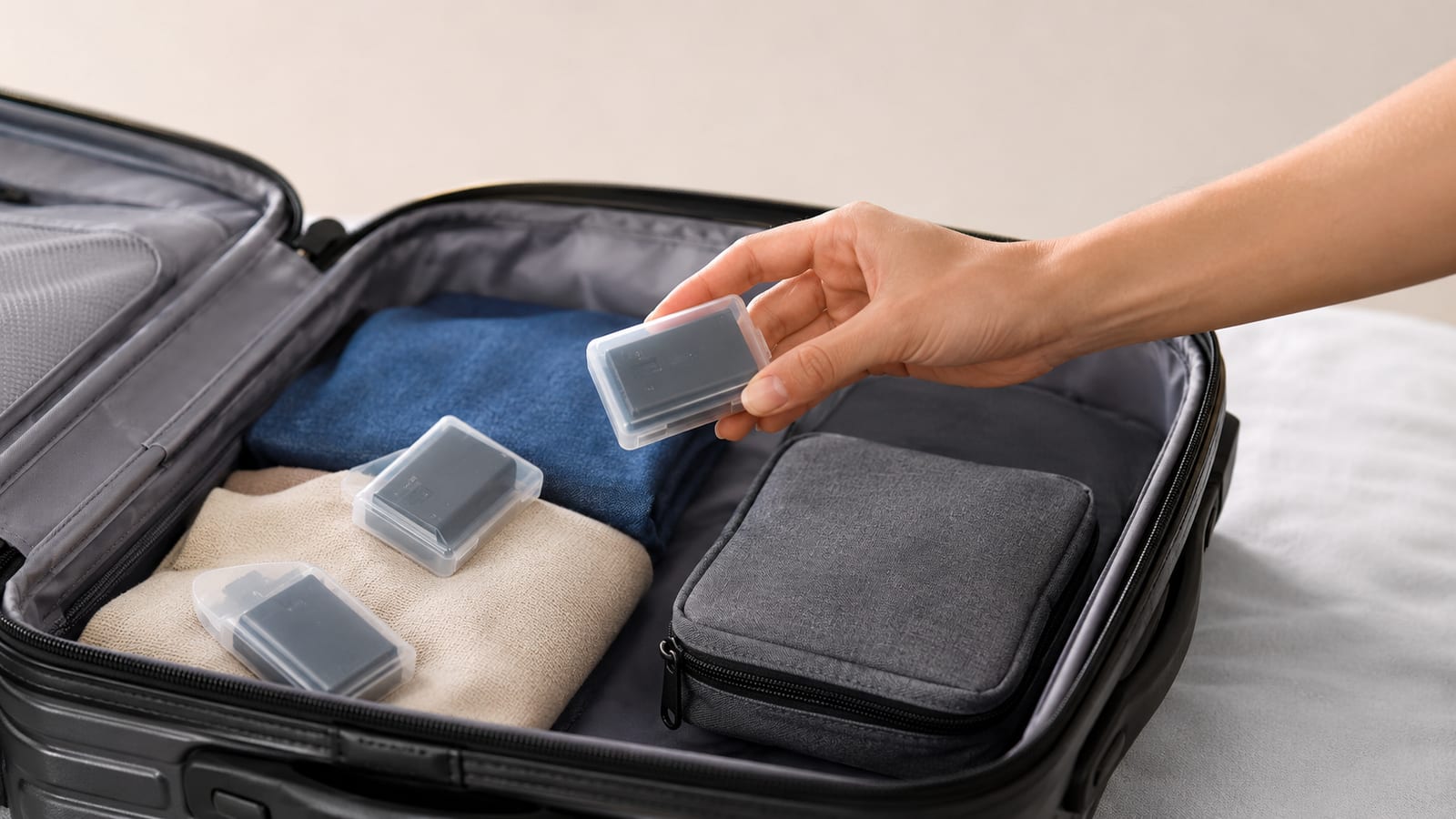
Cover the terminals before you leave home. The real risk is a battery touching keys, coins, cables, or another battery and creating a short circuit.
Use one of these simple methods:
- Leave each battery in its original retail packaging.
- Put each battery in its own protective case.
- Fit a terminal cap if the battery came with one.
- Cover exposed contacts with non-conductive tape.
- Keep batteries away from loose metal objects.
Don’t toss several camera batteries into one pocket with a fistful of charging cables. A neat electronics pouch helps, but separate contact protection still matters. For more practical bag organization, see what actually helps when living out of a backpack.
Leave damaged, swollen, leaking, or recalled lithium batteries at home. Don’t press a swollen battery back into its case or tape over obvious damage. Check the maker’s recall instructions and replace it before you fly.
What are the rules for lithium-ion batteries?
Rechargeable lithium-ion batteries power most phones, laptops, cameras, power tools, and portable chargers. The rule turns on two details: whether the battery is installed and how many watt-hours it holds.
A lithium-ion battery rated at 100 watt-hours or less may be carried without airline approval. A loose battery still belongs in your carry-on, even when it falls below that limit.
Lithium-ion batteries need protection from damage and short circuits. So keep spares separate, don’t carry a crushed battery, and don’t use a power bank that gets unusually hot.
The cabin rule isn’t airport fuss for its own sake. If a battery starts smoking, the crew needs to see it and deal with it. A fire inside the baggage hold is much harder to manage.
What does the 100 watt-hour threshold mean?
A watt-hour, written as Wh, measures how much energy a battery can store. Lithium-ion batteries at or below 100 Wh are generally allowed in carry-on baggage without special airline approval.
Look for “Wh” on the battery label, power bank, device casing, or technical sheet. If the label gives volts and amp-hours instead, multiply those figures to find watt-hours. If it lists milliamp-hours, convert that capacity to amp-hours first.
Don’t turn up with an unmarked battery and expect the security officer to guess. A clear factory label is the easiest proof. For a battery without one, bring the manufacturer’s technical sheet or a clear product document that matches the model number.
This matters most with large laptop batteries, camera equipment, power tools, and portable power packs. Most phones aren’t the problem. The unlabeled brick at the bottom of your bag is.
Can I bring lithium-ion batteries over 100 watt-hours?
A lithium-ion battery rated from 101 through 160 watt-hours requires airline approval. A spare battery in this range must remain in carry-on baggage, and the airline may limit how many larger spares you can bring.
Contact the operating airline before travel. That means the airline flying the aircraft, which may differ from the company that sold your ticket. Keep its written approval where you can reach it at check-in and at the gate.
Lithium-ion batteries over 160 watt-hours aren’t allowed in normal passenger baggage. Shipping rules may apply instead, so don’t bring one to the airport and try to argue your way through.
This is one place where “I flew with it last time” proves nothing. A missed check on one trip doesn’t change the rule on the next.
What are the rules for lithium-metal batteries?
Lithium-metal batteries are usually non-rechargeable. You’ll find them in some cameras, medical devices, watches, and specialist equipment.
A spare lithium-metal battery may contain no more than 2 grams of lithium. It must travel in carry-on baggage and be protected from damage and short circuits.
The label may show lithium content rather than watt-hours. If it doesn’t, check the maker’s document before packing it. Don’t use the lithium-ion watt-hour rule as a substitute because these are different battery types.
Larger lithium-metal batteries don’t fit the normal spare-battery allowance. Contact the airline before travel rather than taking a guess at security.
Do I need airline approval for my batteries?
You don’t usually need airline approval for a lithium-ion battery at or below 100 Wh. You do need approval for one rated from 101 through 160 Wh.
Airlines can set tighter conditions than the basic federal rules. They may also have separate procedures for medical equipment, mobility aids, professional camera gear, and battery-powered tools.
Before you fly, check the live Federal Aviation Administration PackSafe battery guidance and the operating airline’s baggage policy. The Transportation Security Administration battery guidance is also useful for security screening, but the airline controls what it accepts aboard its aircraft.
Don’t rely on an old screenshot labeled with a year. Battery rules and airline policies can change, while search results have a habit of keeping stale advice alive.
Can I bring a power bank or charging case on a plane?
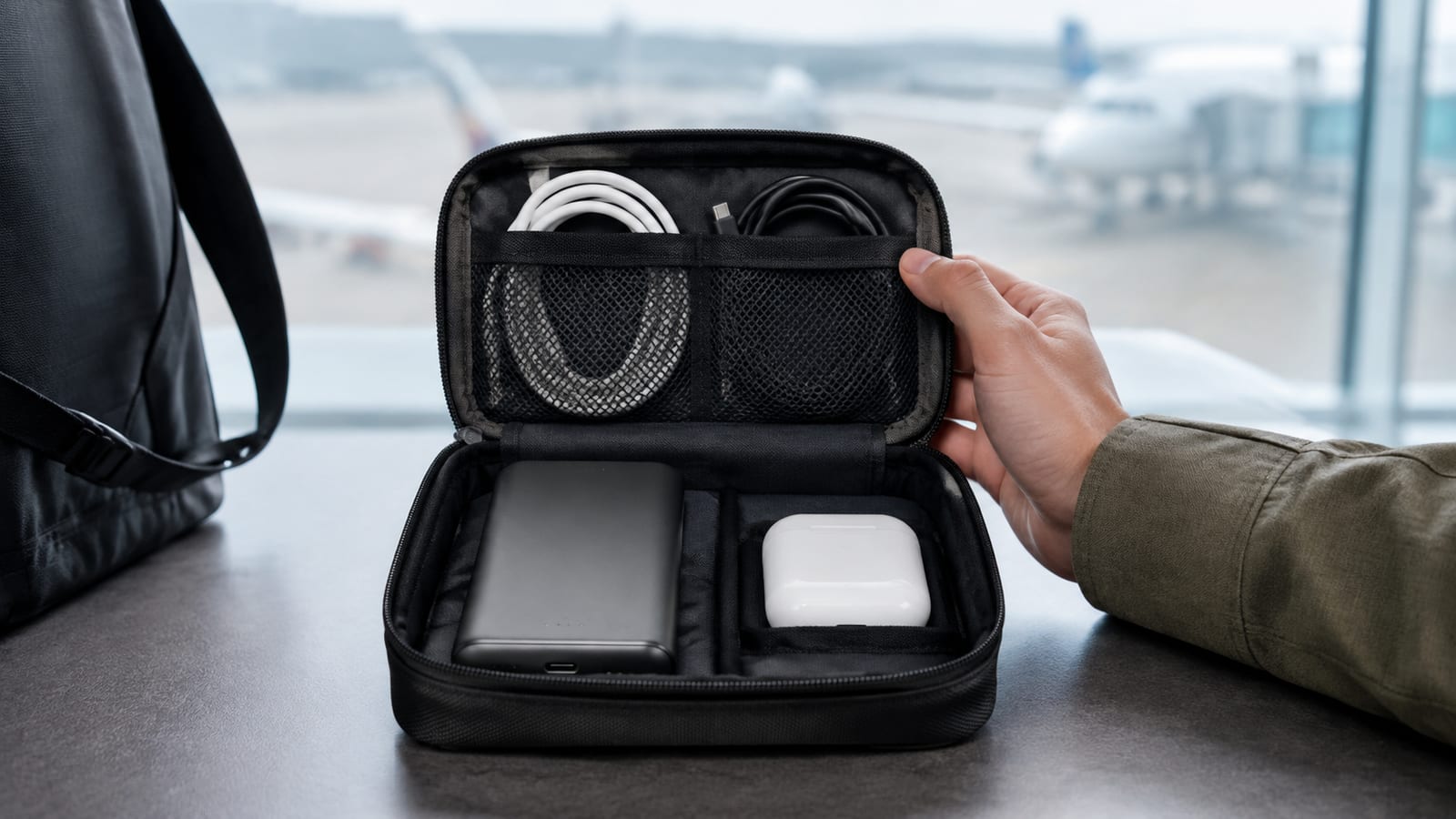
Yes, but a power bank belongs in your carry-on and cannot go in checked baggage. Airlines treat portable chargers and battery charging cases as spare lithium batteries, not as ordinary cables or accessories.
Check the watt-hour rating before you pack. A power bank at or below 100 Wh generally doesn’t need airline approval. A larger one in the approval range needs permission from the airline, while anything above the passenger limit must stay home.
Protect the power button from accidental activation. Also, stop using the bank if it swells, cracks, smells odd, or becomes unusually hot.
Keep it where you can reach it during the flight. However, follow crew instructions about charging and storage, since an airline may restrict power bank use even when carrying the bank is allowed.
What should I do if security or the airline questions my battery?
Stay calm and make the battery easy to inspect. The person asking may need to confirm its rating, condition, or approval rather than take it away.
Try this:
- Remove the battery or power bank from your bag.
- Show the watt-hour label and model number.
- Explain whether it’s a spare or installed in a device.
- Show written airline approval if the rating requires it.
- Offer the matching technical sheet if the label is unclear.
- Follow the crew’s packing or storage instructions.
Don’t peel off labels, carry swollen cells, or hide a power bank inside a checked suitcase. If the airline won’t accept the battery, your practical choices are to leave it behind or miss the flight.
Before heading to security, put batteries and liquids in separate, reachable parts of your bag. The rules aren’t the same, so this guide to the TSA liquids rule will help you avoid mixing up two different checks.
The first action is simple: take every spare battery and power bank out of your checked bag now.
FAQ
Can I pack AA or AAA alkaline batteries in checked luggage?
Yes. Typical non-lithium dry batteries, including alkaline AA, AAA, C, D, button-cell, and 9-volt batteries, may go in checked baggage.
However, protect them from damage, sparks, and dangerous heat. Cover exposed contacts where needed, especially on 9-volt batteries, and don’t leave them loose beside metal objects.
Can I bring a vape or electronic cigarette on a plane?
Electronic cigarettes and vaping devices belong in carry-on baggage only. They aren’t allowed in checked baggage.
Each lithium-ion battery in the device must not exceed 100 Wh. If it uses lithium-metal batteries, each one may contain no more than 2 grams of lithium. Prevent accidental activation and don’t charge or use the device unless the airline permits it.
Do international flights use the same battery rules?
Many countries and airlines follow similar air-safety standards, but local screening and airline policies can differ. Check the rules for every operating airline, including a regional carrier on a connecting flight.
Also check the departure airport’s security authority if you’re flying home from another country. Approval from one airline doesn’t automatically bind the next one.
Can I carry several small camera batteries?
Small camera batteries are usually fine when each one stays within the standard lithium-ion limit. Keep every spare in your carry-on and protect its contacts separately.
However, an unusually large quantity may look commercial rather than personal. Ask the airline in advance if you’re carrying professional production gear or a case full of spares.
What if my battery has no watt-hour label?
Find the matching technical sheet using the manufacturer and model number. Save it on your phone and keep an offline copy in case airport Wi-Fi lets you down.
If neither the battery nor its documentation proves the rating, skip it. Security staff and airline agents don’t have to accept your estimate.