Zadar is worth visiting for its compact Old Town, Roman Forum, waterfront, Sea Organ, and easy swimming near the centre. For what to do and what to see in Zadar, Croatia, give the city at least one full day. Start with the historic streets, swim or slow down in the afternoon, then claim a place by the Sea Organ before sunset.
Last updated: 2026-08-12
Zadar works best at an unhurried pace. Dubrovnik has the famous walls and Split has Diocletian’s Palace, but Zadar feels easier to take in on foot. You can see the main sights, eat well, and still sit by the Adriatic without sprinting between them.
What should you do and see in Zadar, Croatia?
Start in Zadar Old Town and work toward the waterfront. The city is small enough for this order to make sense, and it keeps the best moment for the end of the day.
Here is the order I’d use:
| Priority | Place | Why it earns your time |
|---|---|---|
| 1 | Zadar Old Town | Roman ruins, Venetian gates, quiet lanes and small squares |
| 2 | Roman Forum and St. Donatus | The strongest history pairing in the city |
| 3 | Waterfront and Sea Organ | Zadar’s essential sunset experience |
| 4 | Greeting to the Sun | A quick light display beside the Sea Organ |
| 5 | Kolovare Beach | The easiest central swim |
| 6 | Museum of Ancient Glass | The best indoor choice when the heat or rain gets tiring |
The Sea Organ is the one sight I wouldn’t postpone. Go near sunset, sit on the broad waterfront steps, and stay as the light fades. The waves push air through the organ’s pipes, so the sound keeps changing. It isn’t a concert and it isn’t polished. That’s why it works.
Afterward, walk a short distance to Greeting to the Sun. The installation is a circle with a diameter of 22 meters, made with three hundred multi-layered glass plates. Photovoltaic solar modules sit beneath the glass, and lighting elements turn on at night to produce a light show.
See it after the Sea Organ, not instead of it. The light display is fun for a few minutes, but the waterfront and the sound deserve the longer stop.
Simple things to do beyond sightseeing
The best parts of Zadar don’t all look like attractions. Swim before lunch, browse the market, take a slow coffee, and leave room for the city to feel ordinary.
I’d build the day around these simple stops:
- Swim near the centre. Kolovare Beach is the practical choice when you don’t want to arrange transport. The waterfront also has places where you can enter the sea from the edge, though you’ll want sturdy sandals on rough stone.
- Browse the market. Look for fruit, vegetables, cheese, bread and local products. Go in the morning, when the stalls feel useful rather than decorative.
- Take coffee in a square or side street. Pick a table where people are actually stopping, not a place with a menu aimed only at passing visitors.
- Walk the waterfront twice. Go once in daylight to understand the space. Return before sunset when everyone gathers for the same reason.
- Visit the Museum of Ancient Glass. It’s a strong indoor choice if the afternoon heat gets hard to ignore. The collection includes over 5,000 glass objects dating from the 1st century BC to the 5th century AD. More than 1,500 complete glass objects are shown in the permanent display, divided into eight thematic sections.
- Have a long lunch. Dalmatian food suits a slower day. Look for grilled fish, squid, octopus, local cheese, seasonal vegetables and pasta with seafood.
Zadar is also a good base for a boat trip or a national park, but don’t force a day trip into a one-day visit. If you have extra time, compare the options in this guide to national parks in Croatia before booking anything.
The trade-off is simple. Zadar gives you more time to sit down, but only if you stop treating every free hour as a problem to solve.
A practical route through Zadar Old Town

Enter through the Land Gate if you’re approaching from the mainland side, then let the route loosen. You don’t need a perfect walking line here. You need a few fixed points and enough time for the lanes between them.
I’d follow this rough route:
- Start at the gates and city walls. Notice the Venetian details before you head into the busy centre. Zadar’s defensive walls form part of the Venetian Works of Defence site listed by UNESCO.
- Walk toward Five Wells Square. Five Wells Square was constructed in 1574, and its wells once served a practical purpose during periods when access to water mattered for the city’s survival.
- Continue through the lanes toward the Roman Forum. The streets shift from everyday cafés and shops to open stone, columns and fragments.
- Pair the Forum with St. Donatus. They sit beside each other, which saves you from crossing the Old Town for separate history stops.
- Walk to St. Anastasia’s Cathedral. Look up as you approach. The façade and bell tower give this part of the Old Town a different weight from the lower Roman ruins.
- Finish along the waterfront. Walk past the Sea Organ and stop near Greeting to the Sun only when the sky begins to darken.
The route is easy on foot, but the stone can be uneven and slippery after rain. Wear shoes you can walk in for several hours. Sandals that barely stay on your feet are a poor choice here.
Don’t spend the whole afternoon hunting for every named square. Walk the main route once, then return to the corner or café that caught your attention. Zadar’s small details sit in the spaces between the landmarks.
Why are the Sea Organ and Greeting to the Sun best at sunset?
The Sea Organ and Greeting to the Sun are best treated as one waterfront stop with two very different parts. Arrive before sunset, find a place on the steps, and stay through dusk.
The Sea Organ needs time because the sound depends on the water. Some waves produce a low note. Others give you a thin whistle or a sudden cluster of sounds. People talk, children move around, and the sea keeps interrupting everything. Don’t expect silence or a neat performance.
Sit facing the water rather than standing over the openings. You’ll hear more, and you won’t spend the whole time trying to take a photo of something you can’t see.
Then walk to Greeting to the Sun as the daylight goes. Its solar panels collect energy during the day, and the lights come on after dark. The changing colours make it an easy stop for families and children, while the Sea Organ is the stronger experience for adults who want to sit and listen.
Avoid arriving at noon just to say you’ve been. The Sea Organ still makes sound, but the waterfront loses its best setting. Also, don’t leave as soon as the sun touches the horizon. The useful part comes during the shift from daylight to dusk.
The historic sights worth your time
The Roman Forum, St. Donatus, St. Anastasia’s Cathedral and the city walls give you enough history for a first visit. Add Five Wells Square for the practical story of how the city worked. You don’t need to enter every church or museum to understand Zadar.
How should you pair the historic sights?
Roman Forum
The Roman Forum in Zadar was founded in the 1st century BC. Today, you walk among fragments rather than a complete Roman town, which is exactly the point. The stones are mixed into the living city, with people crossing the space on their way to lunch or the cathedral.
Give the Forum a slow circuit. Look at the columns, the worn surfaces and the buildings that press close around it. It’s better to notice how the old city has been reused than to stand there searching for one perfect Roman view.
Church of St. Donatus
Construction began in the second half of the 8th century and was supposed to have been completed in the 9th century.
Go inside if it’s open, then return to the Forum outside. The round interior gives the building a clear shape, and the pairing makes the history easier to read. On its own, St. Donatus can feel like a quick photo stop. With the Forum beside it, the visit has a reason.
St. Anastasia’s Cathedral
St. Anastasia’s Cathedral is worth seeing for its scale and façade. It gives you a break from the low stone remains of the Forum and shows how Zadar’s religious centre developed over time.
Go during the quieter part of the day. If a service is taking place, stay respectful and wait before entering. You’re visiting a working church, not a stage set.
City walls and Five Wells Square
The walls make more sense when you look at them as working defences rather than background scenery. Walk along the sections you can reach and notice the gates, stonework and changing views into the Old Town.
Five Wells Square is a small stop, but I’d keep it. The wells at Five Wells Square were constructed in 1574, and the square connects the city’s grand history to a plain problem: people needed water. That practical detail is more memorable than another vague claim about the city’s past.
If you want a deeper comparison of Croatia’s historic cities, my guide to Dubrovnik and Split will help you decide where Zadar fits into a longer route.
Where can you swim and sunbathe near Zadar’s centre?
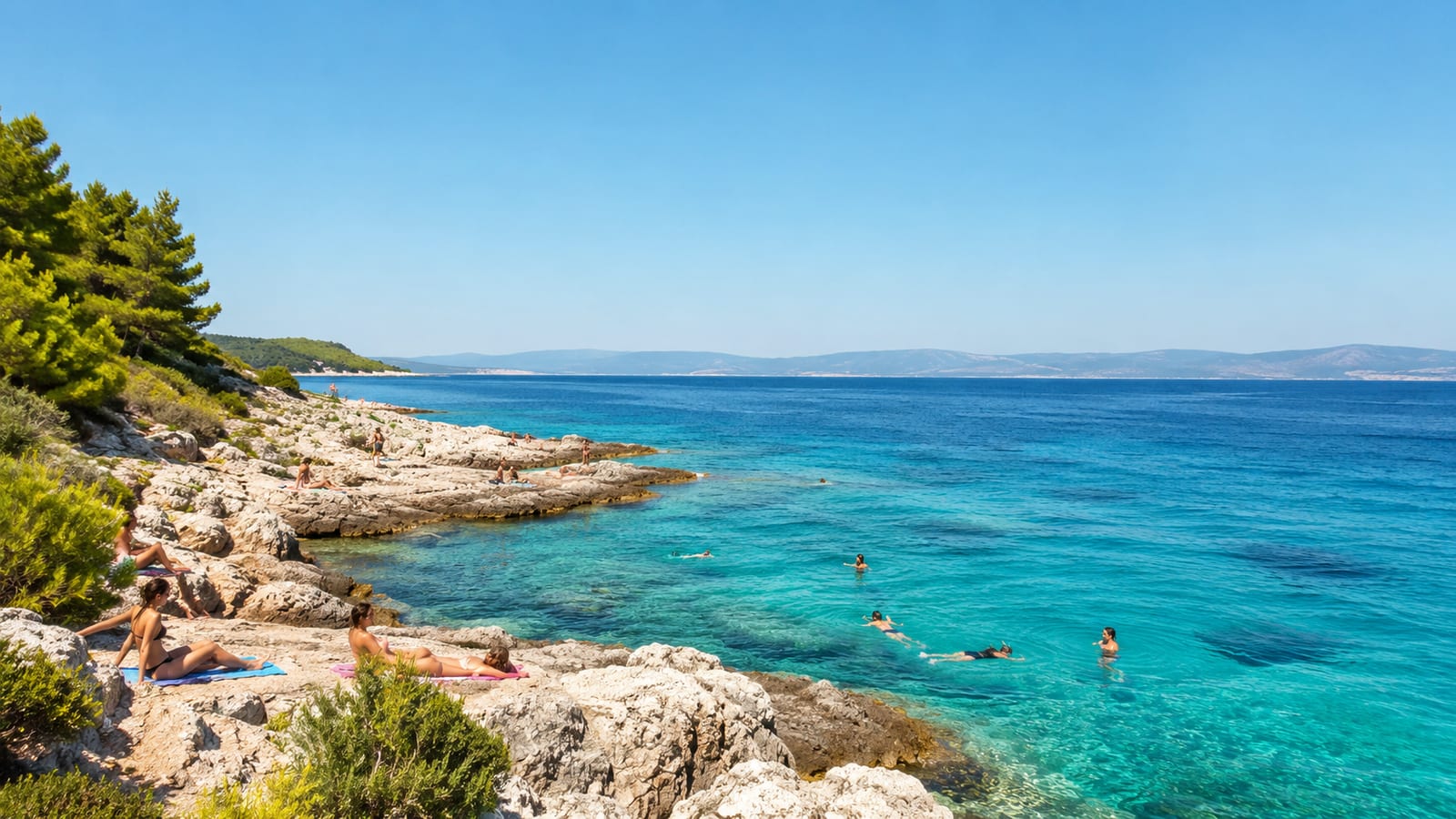
Choose Kolovare Beach for the easiest central swim. It’s the sensible option when you’ve only got a day and don’t want to turn swimming into a transport project.
Kolovare is close enough to combine with the Old Town, especially if you swim in the morning and walk into the centre afterward. Bring your own towel, water, sun protection and sandals. Beaches and waterfront edges around Zadar can be pebbly, rocky or hard underfoot.
For a quick dip, use the waterfront swimming spots near the Old Town. They save time and make sense between sightseeing stops. However, they’re less comfortable for a long beach afternoon. You may find stone edges, limited shade and nowhere convenient to leave your things.
Choose a farther beach when you want a proper half-day by the sea. That can be worth it if you have more than one day, but it’s unnecessary for a first visit built around the Old Town and sunset.
I’d skip the idea of finding a perfect sandy beach near every sight. Zadar’s coast is often about clear water and stone edges, not soft sand. Wear shoes that handle the entrance, keep your valuables with you, and swim when the place is less crowded.
Eating well in Zadar

Eat breakfast near the Old Town market, take lunch away from the busiest waterfront lanes, and choose dinner by the menu rather than the view. The restaurants with the best location aren’t automatically the best meal.
For breakfast, look for coffee, fresh bread, pastries, fruit and something filling enough to carry you through the morning. A café with a counter or window seat works well if you’re travelling solo. You can eat without being hurried into ordering more.
For lunch, seek out local ingredients and a short menu. Grilled fish, seafood pasta, squid, octopus, cheese and vegetables are better clues than a menu listing every international dish. If the restaurant has photographs of every meal and someone outside is waving you in, I keep walking.
Dinner is the time to slow down. Look in the streets just away from the busiest squares, where the menu is smaller and the tables have regulars. Ask what’s fresh rather than ordering the dish with the loudest description.
You can also use this guide to Croatian food worth seeking out before you arrive. Learn a few food words, check whether bread or water carries an extra charge, and ask for the bill when you’re ready. Service may not move at the speed you expect, so don’t schedule a landmark immediately after dinner.
One excellent day in Zadar
One day is enough for the main sights if you stop trying to see everything. Here’s the plan I’d use.
Morning: market, wells and Roman Zadar
Start with breakfast near the market. Browse the stalls afterward, then walk toward Five Wells Square and the city gates.
Move on to the Roman Forum and Church of St. Donatus while you still have energy for history. Add St. Anastasia’s Cathedral if it’s open and the timing works. If it doesn’t, don’t force it. You’ll see the cathedral from outside as you continue through the Old Town.
Early afternoon: swim and slow down
Have lunch away from the busiest lanes. Then choose your break.
Go to Kolovare Beach if you want a proper swim. Stay near the centre if you’d rather sit at a café, browse a museum or return to your room. The point is to create space before the evening, not to fill it with another attraction.
The Museum of Ancient Glass is the better choice if it rains or the heat makes walking unpleasant. It gives you a focused indoor visit without asking you to spend the whole afternoon inside.
Evening: dinner and the waterfront
Have dinner before you reach the waterfront, or eat afterward if you prefer a later meal. Either way, leave enough time to arrive before sunset.
Claim a place on the steps by the Sea Organ. Listen through the change in light, then walk to Greeting to the Sun once the installation begins to glow. Stay for a few minutes and then wander back through the Old Town.
That is a full day with history, swimming, food and Zadar’s best evening scene. Nothing important requires a sprint.
How many days Zadar needs
Give Zadar one full day at minimum. Two days are better if you want a beach afternoon, a museum, a slower meal or a boat trip without cutting into the Old Town.
Zadar Airport is outside the centre, so check your arrival and departure transport before travel day. Depending on your timing, a bus, shuttle, taxi or pre-arranged transfer may make more sense. Don’t assume you’ll step off the plane and walk straight into the Old Town.
Avoid these common mistakes:
- Don’t visit the Sea Organ at midday and leave. The sound is there, but the sunset setting is the reason to make it a main stop.
- Don’t treat Greeting to the Sun as the headline. It’s a short companion stop after the Sea Organ.
- Don’t book a packed day trip on your only day. You’ll lose the city’s best parts, which are close together and easy to miss when rushed.
- Don’t expect every beach to be sandy. Bring sandals for pebbles and stone.
- Don’t eat beside the busiest square without checking the menu. Foot traffic can hide average food and inflated prices.
- Don’t plan every lane in the Old Town. Keep the Forum, cathedral, Five Wells Square and waterfront as your anchors.
- Don’t leave the sunset stop until the last minute. Popular waterfront steps fill before the sky changes.
Zadar is for you if you like history in small doses, swimming close to town, seafood, evening walks and cities that don’t need constant management. Skip it as a rushed day trip if you’re only going to photograph the Sea Organ and leave.
FAQ
Is Zadar good for solo travellers?
Yes. The Old Town is compact, easy to walk, and full of cafés where sitting alone doesn’t look unusual. Pick a window seat, keep your route simple, and use the waterfront as your evening anchor.
Can you visit Zadar without a car?
Yes, if you’re staying in or near the centre. The main sights, restaurants and central swimming options are reachable on foot. A car becomes useful for beaches and day trips, not for the Old Town itself.
Is Zadar suitable for a rainy day?
Yes, but you’ll need to change the plan. Use the Museum of Ancient Glass, take a long lunch, browse covered market areas, and walk the Old Town between showers. The Sea Organ still works in rain, though the waterfront will be less comfortable.
Should you choose Zadar or Split for a short Croatian city break?
Choose Zadar for a calmer, more compact visit built around sunset, swimming and layered history. Choose Split if you want a larger city, a busier nightlife scene and Diocletian’s Palace as the main historic focus.
What’s the first thing to do after arriving in Zadar?
Walk to the waterfront before committing to a long sightseeing route. Find the Sea Organ, note the sunset position, and then return to the Old Town with a clear sense of where the evening will finish.