One small bag is plenty for a week, and it changes how the whole trip feels. Learning how to travel with only a personal item comes down to three moves: pick a soft bag that fits your airline's under-seat limit, pack clothes you can wear twice, and swap liquids for solids. Do that and you skip the bag drop, skip the fight for overhead space, and walk out of arrivals ready to wander.
The catch is that "personal item" means a different size on every airline. The smallest limit on your ticket sets the rules. So get the bag right first, because everything after that is just packing.
Personal item or carry-on: what's the difference
On most airlines you get two things in the cabin. The carry-on is the bigger bag that goes in the overhead bin. The personal item is the smaller one that slides under the seat in front of you, like a backpack, a tote, a laptop bag, or a purse.
Budget airlines changed the math. Spirit and Frontier charge for a carry-on, so the personal item is the only free bag you get. Even on bigger airlines, the cheapest fares sometimes leave out the carry-on.
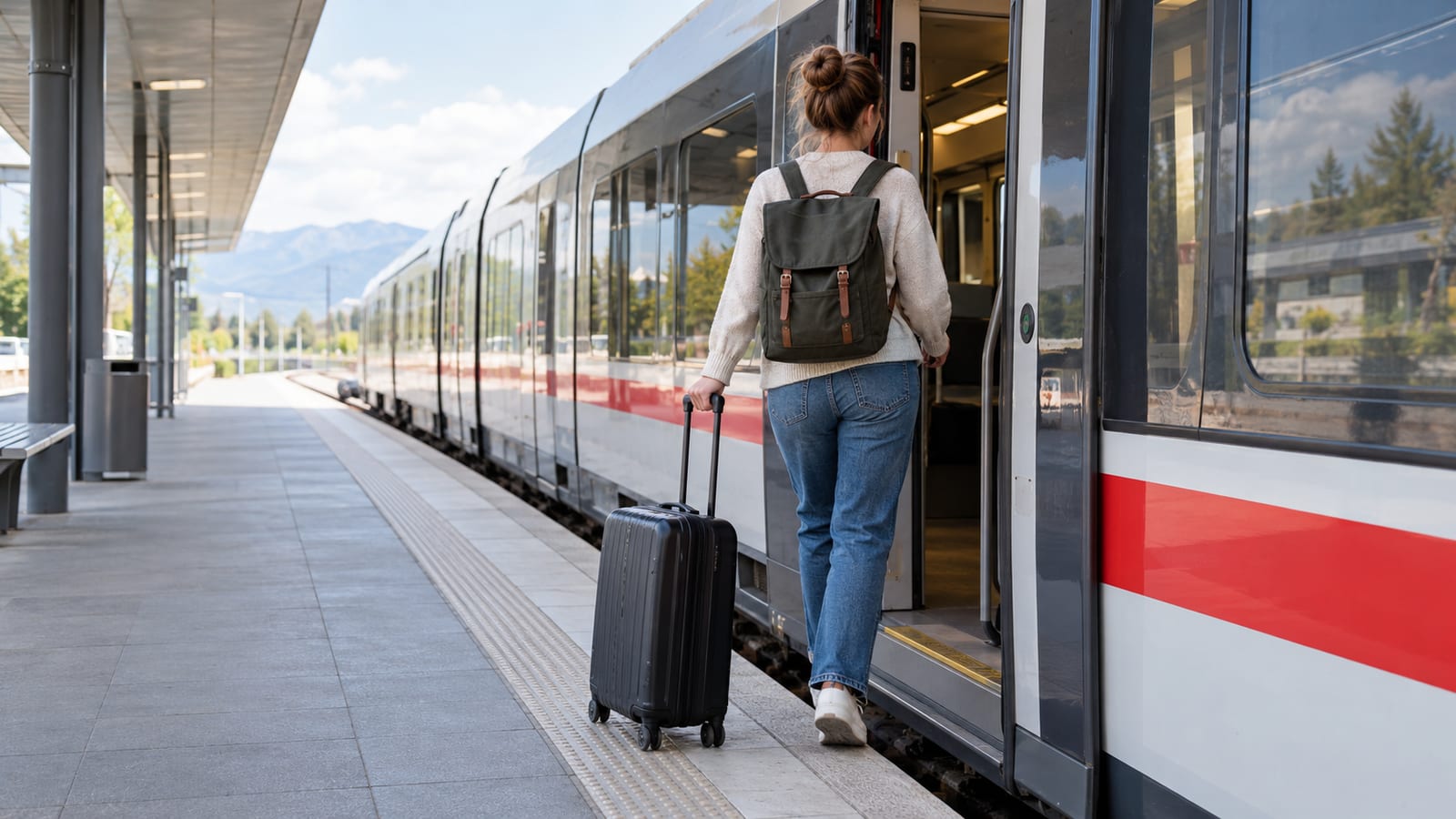
The under-seat bag also stays with you after you land. It becomes your day bag, your train bag, and your café bag. That part matters most once you're dragging a roller up a cobbled hill in Lisbon.
How big can a personal item be?
Each airline sets its own limit, and the numbers aren't close. Here are the published personal-item sizes for four US airlines:
| Airline | Personal item limit | Worth knowing |
|---|---|---|
| United Airlines | Maximum total of 9 x 10 x 17 inches (22 x 25 x 43 cm) | The smallest of the four by a wide margin |
| Southwest Airlines | Up to 16.25 x 13.5 x 8 inches | Must fit under the seat |
| Spirit Airlines | At most 18 x 14 x 8 inches (45 x 35 x 20 cm) | Only one personal item per passenger |
| Frontier Airlines | Under 14 x 18 x 8 inches (35 x 45 x 20 cm) | Close to Spirit's size |
Look hard at United's height. That limit means a small backpack, and it decides everything if you fly with them. Here is what I do: find the smallest limit on every flight in the trip, connections included, and pack for that one.
Limits change, so check your airline's baggage page the week you fly. Read the size off the airline's own site. Forum posts and old videos go stale fast.
Pick the bag before you pack anything
Go soft-sided. A fabric backpack gives a little when a gate agent asks you to try the sizer box, while a hard case gives nothing. Skip wheels too, because the handle and frame eat space you can't spare in a bag this small.
Inside, look for a laptop sleeve against the back panel. That way the laptop slides out at security without you emptying the whole bag. I also want a clamshell opening that unzips flat like a suitcase, since a top-loading bag turns into a pit by day three.
Then measure it full. A bag that fits when empty can bulge past the limit once it's packed, and the front pocket is usually the culprit. So stuff it, zip it, and run a tape measure along every side, handles included.
Finally, try the straps. You'll wear this bag through the airport, on the train, and around a new city on foot. If it feels awkward in the shop, it will feel worse by evening.
How do you travel with only a personal item?
Pack in this order. It stops you from cramming everything in and then sitting on the bag to close it.
- Check every airline on your ticket. Write down the smallest personal-item size and pack to that.
- Lay out everything you want to bring. Then put back anything you'd only wear "just in case."
- Build around a few colors that all match. Every top should work with every bottom, so fewer pieces make more outfits.
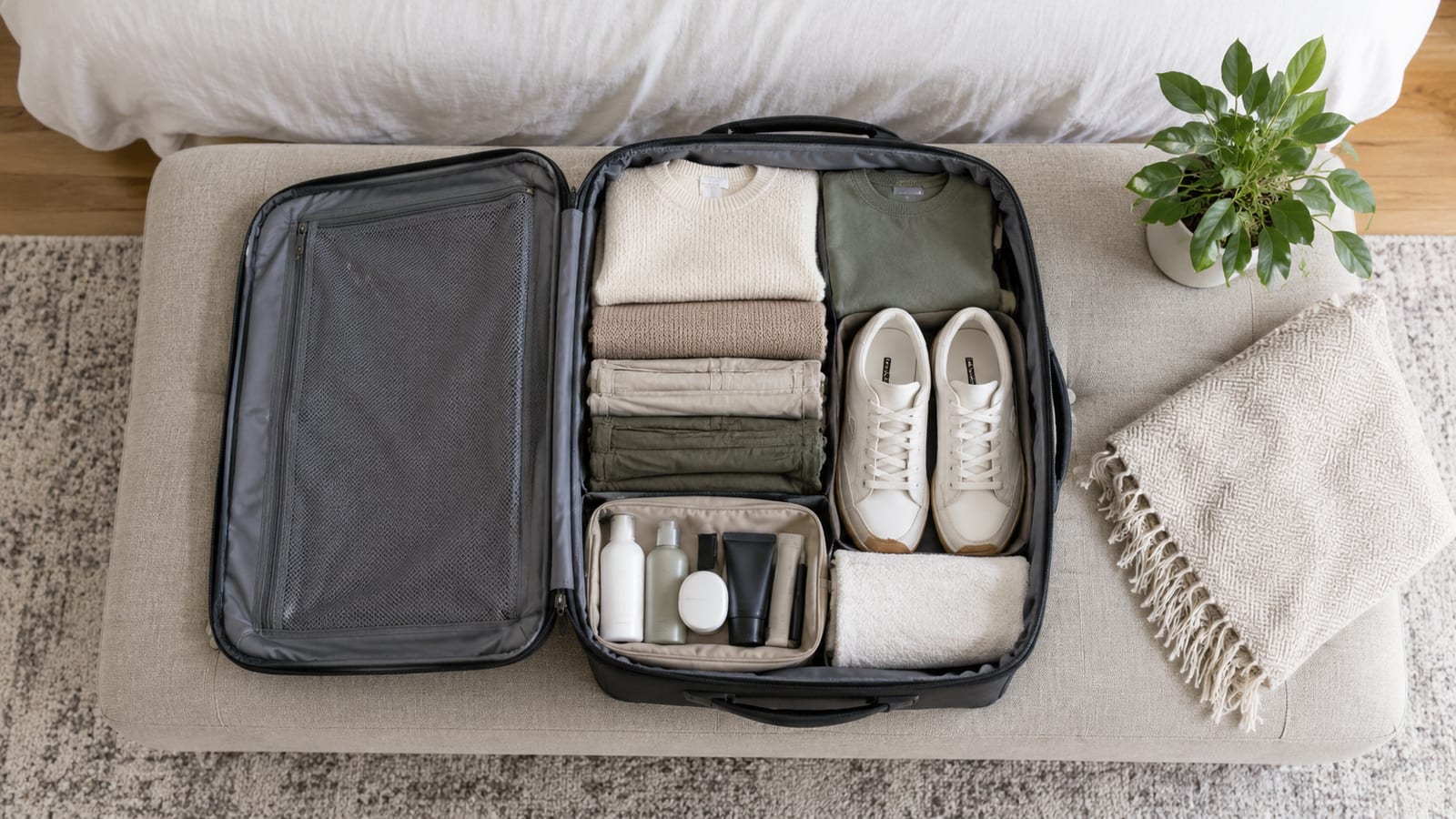
- Pack clothes in a compression cube. Rolling works too, but a cube keeps the bag square, and a square bag fits a sizer better.
- Put toiletries in last, near the top. Solids can go anywhere. Any liquids should sit where you can pull them out fast at security.
- Load the outer pocket for the flight. Passport, phone, charger, headphones, a pen for arrival forms, and a snack.
- Wear your bulkiest things. Boots, jacket, and the thick sweater go on your body (more on that below).
- Do a walking test. Carry the packed bag up your stairs and around the block. If it digs into your shoulders now, it'll be worse after a full day on foot.
Do this a few days before you leave, with no rush. Packing the night before is when the extra sweater sneaks back in.
What fits for a week
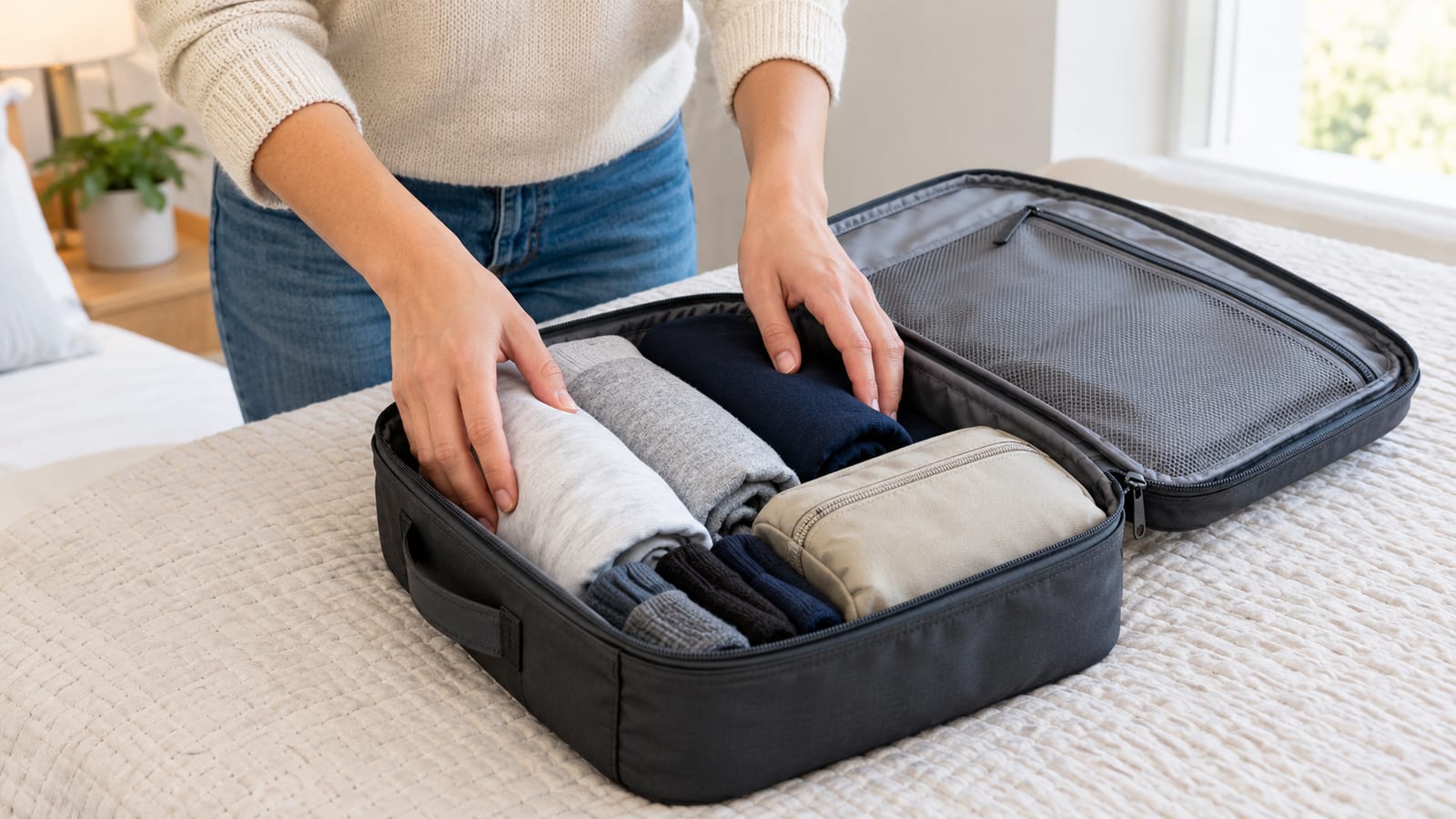
Clothes for about a week fit in a small backpack if you plan to do laundry once. Here is what goes in mine for mild weather:
- 3 tops, one a little nicer for dinner
- 1 extra pair of pants or a skirt, plus what I'm wearing
- 4 to 5 pairs of quick-dry underwear and socks
- 1 light layer, like a fleece or thin sweater
- Sleepwear that doubles as lounge clothes
- A swimsuit if there's any chance of water
- Phone, one charger, a short cable, a plug adapter
- A small toiletries kit, mostly solids
- Passport, a backup card, and some cash in a flat pouch
The trick is fabric. Merino wool and quick-dry synthetics hold up to more than one wear and dry overnight on a hanger. Wash them in the sink with a bar of soap, and this kit stretches as long as you like.
Shoes are the hard part. Bring one pair you can walk in all day and wear it on the plane. If you need a second pair, make it flat sandals, because a second pair of sneakers will swallow half the bag.
For longer stretches, my notes on living out of a backpack cover what keeps a small wardrobe working week after week.
Wear the bulky stuff on the plane
Your body is free luggage. Wear the heaviest shoes, the jacket, and the thick sweater through the airport, even in July. Planes run cold anyway, so the sweater earns its place once you sit down.
A jacket with deep pockets helps too. Your phone, passport, and earbuds can ride in it during boarding, which slims the bag right when the gate agent is looking. Once you're seated, take it off and fold it on your lap.
Still, there's a limit. Wearing four layers to dodge a fee makes you miserable for the whole flight. Pack for the trip you're taking, not the one you're dreading.
Liquids are where most bags overflow
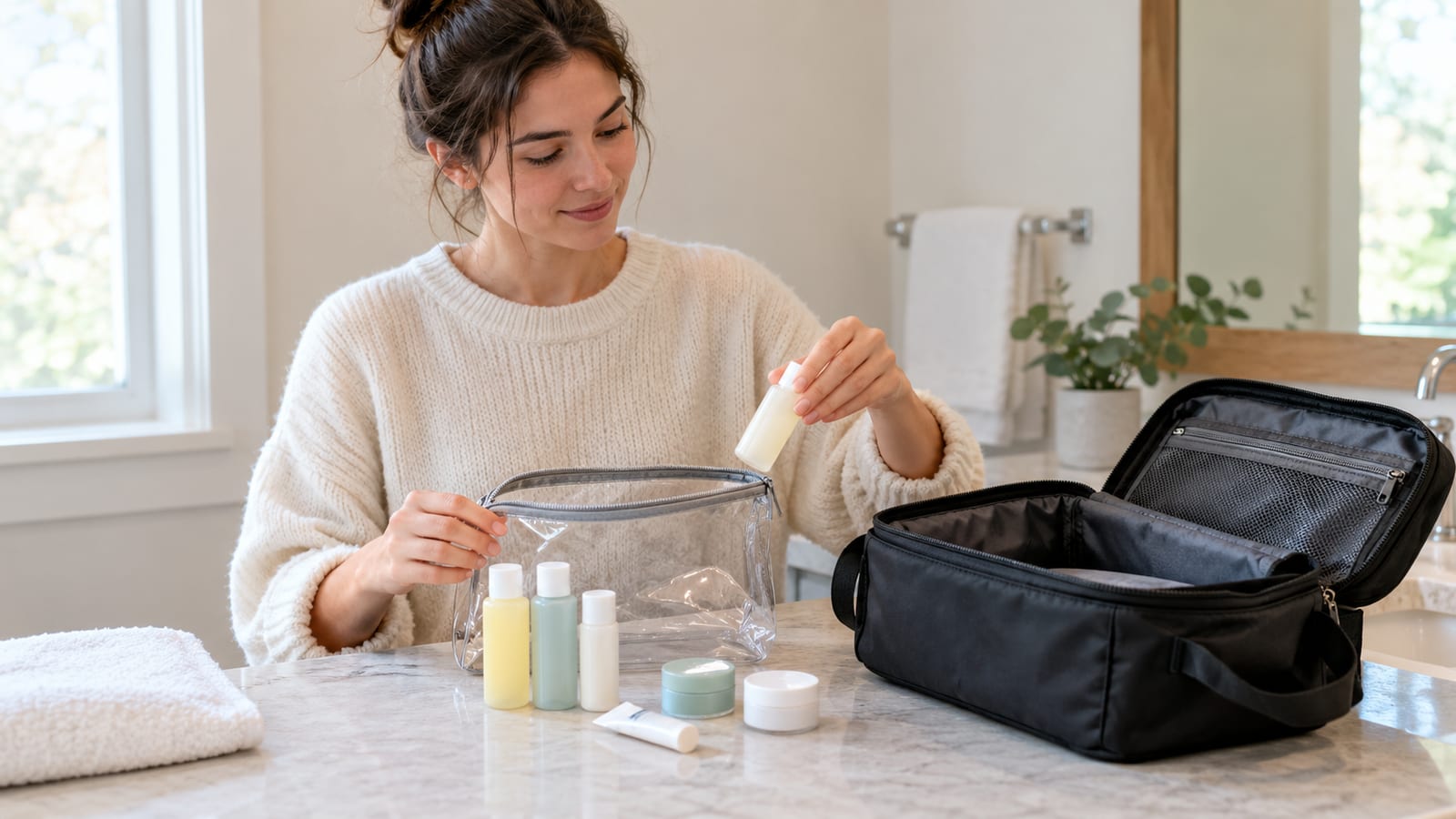
Toiletries take more room than people expect, because bottles are bulky and the clear bag never sits flat. Under the official TSA liquids rule, carry-on liquids, gels, creams, and pastes must be in containers of 3.4 ounces (100 milliliters) or less each. My guide to what the 3-1-1 rule means at security walks through the bag and the screening line.
The easier fix is to go solid. Shampoo bars, solid conditioner, stick deodorant, toothpaste tablets, and a bar of soap don't count as liquids, so they skip the clear bag entirely. I keep only the few things with no good solid version, like contact solution or a small sunscreen, in liquid form. Here's how to build a liquid-free toiletries kit that fits in a pouch.
Buy the rest when you land. There's almost always a pharmacy within walking distance of your room. Pick up full-size sunscreen there and leave what's left behind when you go.
Keep the weight down
Most US airlines care about size more than weight for a personal item. However, a heavy bag is still a bad idea, because you're the one carrying it. It sits on your shoulders through security, on the train from the airport, and up the stairs to a walk-up room.
The usual offenders are the laptop, chargers, books, and shoes. Swap paper books for an e-reader or your phone. Bring one charger with two ports instead of two chargers, and leave the laptop home if you won't use it.
Pack the heaviest things in the middle of the bag, close to your back. As a result, the same weight carries lighter. It's a small detail, but your shoulders will notice by afternoon.
Where a personal item falls short
This setup doesn't fit every trip, and it's better to know before you're at the gate. Cold places are the big one. A puffer jacket and winter boots fill the bag on their own, even if you wear one of them.
Formal events are hard too. A suit or a dress plus proper shoes won't squeeze into an under-seat bag. The same goes for gear-heavy trips with hiking boots, a real camera kit, or anything for snow.
There's also the trip home. A small bag leaves no room for shopping, and that bottle of olive oil from a market in Florence can't fly home with you as a carry-on liquid. If you plan to buy things, either ship them or accept paying for a checked bag on the return.
Making the most of it once you land
The payoff starts at arrivals. With no carousel to wait at, you can walk straight to the train or bus. One bag makes public transport easy, which is why I lean on getting around without a rental car on almost every trip.
A small backpack also fits in a hostel locker, which many big roller bags don't. Once you check in, leave the clothes cube in your room. The empty bag becomes your day bag for wandering.
If you like a purse or crossbody, know that it usually counts as your one personal item. So fold it flat inside the main bag before boarding and pull it out after you land. Then it's ready for evenings out while the bigger bag stays at your room.
When it rains, line the bag with a trash bag or pack a rain cover. The walk from the station is where clothes get soaked. One bag, both hands free, and the whole city within walking distance.
Your first step
Look up the personal-item size for your next flight on the airline's own site. Then measure the bag you already own, packed full, before you buy anything new.
FAQ
Does a coat or neck pillow count as my personal item?
A coat you're wearing usually doesn't count on US airlines. Carrying one over your arm can draw a second look at a strict gate, so put it on. Neck pillows are a gray area that varies by airline, and an inflatable one rolls small enough to fit in an outer pocket.
Can I bring food through security?
Yes, solid food like sandwiches, fruit, and granola bars passes through fine. Anything you could spread or pour, such as yogurt, hummus, or peanut butter, falls under the liquids limit. A solid snack from home also saves you from airport prices at the gate.
What happens if the gate agent says my bag is too big?
Stay calm and ask to try the sizer. Moving a pouch or two from the front pocket into your jacket often shrinks the bag enough. If it still won't fit, you'll usually pay to check it, and budget airlines charge the most at that point.
Do prescription liquids follow the size limit?
No. TSA allows medically necessary liquids in larger amounts. Take them out at screening and tell the officer what they are. Original labeled bottles make that conversation quick.